 UPLOAD FILES
Custom Table Covers & Throws: Fit, Fabric & Branding Guide

You ordered a table cover, set it up and noticed that it bunched at the base, short on the sides or creased before the doors opened. That's a common problem, and it matters more than it seems.
Custom table covers sit at eye level at the front of your booth, so they're the branding surface visitors see up close, walk past and photograph most. This guide will show how you can make decisions that make a cover look intentional in terms of style, size, fabric, design, venue and care.
Step 1: Choose Your Style
Most fit problems start here, because table cover can mean four different products.
|
Style |
Look |
Fit |
Under-table access |
Best for |
|---|---|---|---|---|
|
Throw |
Classic drape, soft folds |
Loose, hangs to the floor |
Lift the fabric |
Most tables, flexible branding |
|
Fitted |
Tailored, boxy corners |
Sized to the table |
Depends on the back style |
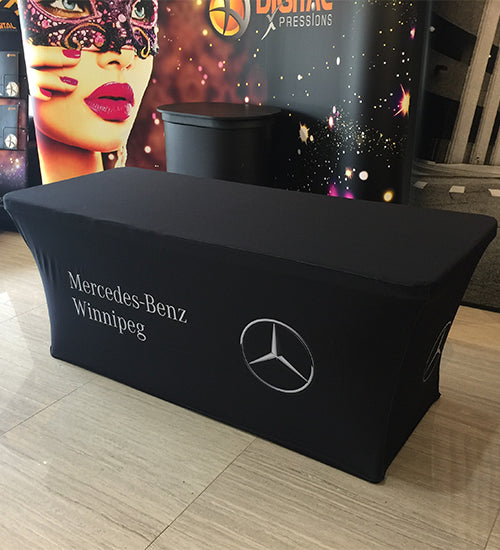
Trade shows, corporate events |
|
Stretch |
Sleek and contoured |
Pulls tight over the frame |
Limited |
Busy booths, modern brands |
|
Runner |
A strip of branding |
Lies across the top and front |
Easy |
Budget upgrades, layered looks |
Custom table throws like the Custom Full Color Table Cover are the most flexible. A fitted table cover looks sharper, and a stretch table cover stays smoothest all day. Some suppliers also sell convertible covers that adjust between table lengths.
The next stage is choosing the back. A 4-sided cover closes all the way around for tables seen from every side. A 3-sided cover leaves the back open so staff can sit and reach stored items.
Step 2: Get the Size and Height Right
Sizing goes wrong when people order by length alone. Before you buy, measure:
-
Length: most event tables are 4, 6 or 8 feet.
-
Depth: standard banquet tables are 30 inches deep, but many display and seminar tables are 24 inches.
-
Height: standard tables are about 30 inches tall. Counter- and bar-height tables need a longer cover.
Then decide between a floor-length cover, which hides boxes and table legs, and a shorter tabletop look for seated guests. For trade shows, floor length is the norm. Compare sizes in the table covers collection.
Step 3: Pick a Fabric That Prints and Travels Well
Most custom table covers are polyester, and for good reason: it takes full-color printing well, resists wrinkles and can be machine washed. Stretch covers add spandex so the fabric grips the table frame.
What about plastic? Plastic covers are cheap and wipe clean, which suits food service and kids' events, but they don't print sharply and look temporary in a branded booth.
Printing matters too. With dye-sublimation, the ink bonds into the polyester fibers instead of sitting on top, so the print won't crack or peel and holds up to washing.
Step 4: Design a Cover That Gets Noticed
On a busy show floor, the front panel does almost all the work. The tabletop is usually covered with products, brochures and a laptop, so:
-
Put your logo on the front, high and centered, at eye level for people walking past.
-
Keep one message. A logo and a short tagline or website beat a paragraph of text.
-
Use high contrast. Dark text on a light cover, or the reverse, reads from across an aisle.
-
Match your booth. Use the same colors as your tent, banners and backdrop so everything reads as one brand.
Done well, trade show table covers turn a plain folding table into branded table covers that tie the whole booth together. For layout ideas, see our guide to trade show booth designs.
Do You Need a Table Runner?
A custom table runner is a strip of printed fabric that drapes across the top and down the front. It's a lower-cost way to add branding over a plain or solid-color cover, and a smart choice if you use different tables at different events. Choose a custom printed table runner when the budget is tight, or layer one over a full cover for a pop of color.
Trade Shows vs. Outdoor Markets
Indoors, a fitted or stretch cover in a 4-sided style gives the cleanest look. Outdoors, wind is the problem, because a loose throw lifts and flaps, so choose a stretch cover or add table clips. At farmers markets and vendor events, match the cover to your canopy so the booth reads as one brand from the aisle. Our guides to custom tents for farmers markets and 10x10 vendor booth ideas show how it all fits together.
Fix Common Fit Problems
|
Problem |
Likely cause |
Fix |
|---|---|---|
|
Bunched at the base |
Throw too long, or the wrong style for the table |
Switch to fitted or stretch, or size down |
|
Short on the sides |
Table is deeper or taller than the cover was made for |
Measure length, depth and height before ordering |
|
Wrinkled on arrival |
Folded tightly in storage |
Roll it, steam it, store it loosely |
|
Slides or shifts |
Loose throw on a busy table |
Use a stretch cover or table clips |
Keep It Wrinkle-Free Between Events
Check the care label, but most polyester covers can be washed in cold water on a gentle cycle, then air-dried or tumble-dried on low. Roll the cover or fold it loosely, and store it in a bag rather than stuffing it into a box. If it creases in transit, a handheld steamer smooths it out in minutes.
Order a Cover That Fits the First Time
Choose your style, size and printed sides in the table covers collection, then upload your artwork or ask for a free custom design. To brand the rest of your booth, pair your cover with custom signs and banners.
Frequently Asked Questions
Are stretch table covers really wrinkle-free?
Very nearly. Because the fabric is pulled tight over the frame, light creases from packing usually disappear once it's on the table. Deep folds from tight storage may still need a quick steam.
Can one table cover fit both a 6-foot and an 8-foot table?
Not usually. Fitted and stretch covers are cut for one table length, and a throw sized for an 8-foot table will pool on the ends of a 6-foot one. Convertible covers can adjust between lengths, but they rarely look as clean as a cover made for one size.
What are people using instead of tablecloths?
Many vendors now use stretch covers, which look more modern and don't blow around, or a runner over a solid-color base cloth. Some skip covers and use branded counters, but a printed cover is still the most affordable way to brand a standard folding table.
How far ahead should I order a custom table cover?
Order as early as you can, ideally a few weeks before your event, so there's time to approve the design proof, produce the cover and ship it. Build in extra time during busy trade show seasons.