
 UPLOAD FILES
Event Signage Ideas for Better Branding, Visibility & Guide Attendees

Your signs start working before your staff do. A guest reads the banner at the gate, follows an arrow to check-in and spots your logo on a tent, all before anyone says hello. When those signs are clear, the event feels organized. When they aren't, guests feel lost before they reach the door.
That is why the best event signage ideas do two jobs at once. They build your brand: "This is who we are." And they guide people: "This is where you go." This guide covers both, with ideas for entrances, wayfinding, sponsors and outdoor sites, plus a material table to help you choose.
What Is Event Signage?
Event signage is any visual display set up for the length of an event to name it, brand it or guide the people attending. That includes a printed welcome banner, a directional arrow, a sponsor wall, a feather flag, a branded canopy and a digital screen showing the day's schedule.
Types of Event Signage
Most event signs fall into four types. Each one answers a different question for the guest.
-
Directional signage answers "Which way?" It uses arrows and a few words to point guests to registration, restrooms, breakout rooms, food and exits.
-
Wayfinding signage answers "Where am I, and how do I get there?" Large venues use maps, zone names and a chain of signs to lead guests across the whole site.
-
Informational signage answers "What is happening, and when?" It shows schedules, session titles, speaker names and house rules, on boards or screens near where people gather.
-
Branding signage answers "Whose event is this?" Banners, backdrops, podium signs and flags carry your logo, colors and tagline in the busiest spots.
Start With the Attendee Journey
Before you choose a single sign, walk the route your guests will take. At each stop, ask four questions:
-
What does the guest need to know here?
-
Where could they get confused?
-
What should they notice first?
-
What should they do next?
Event Signage Ideas for Better Branding
Branding signs help people spot you and remember you. Learn where each one does the most good.
Welcome and Entrance Signs
-
Entrance banners - Hang a large banner with the event name, date and host brand where arriving guests face it. It tells them they are in the right place.
-
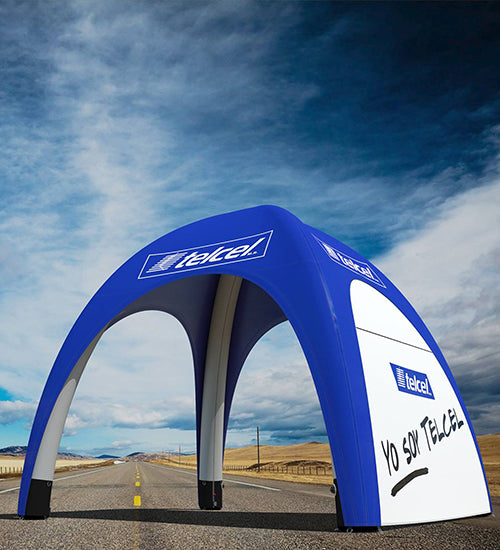
Entrance arches - An inflatable arch marks the gate from a distance and gives guests a photo spot the moment they arrive.
-
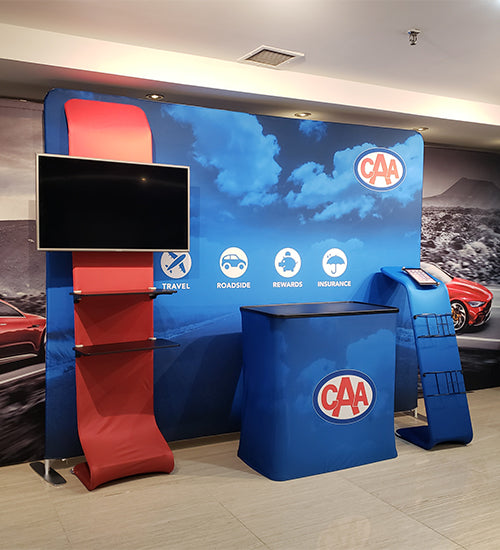
Registration backdrops - A branded backdrop behind check-in shows guests where to line up and turns the first stop into a photo moment.
-
Digital welcome boards - A screen can show greetings, sponsor loops and live schedule changes. It needs power and shade, so it suits indoor entrances best.
Branding and Sponsor Visibility
-
Stage backdrops - Put your logo and theme colors behind the speaker. Keep the design plain, because it will sit behind every photo and video of the event.
-
Sponsor walls - Group sponsor logos on one board near the entrance or stage. One clean wall looks better than logos scattered across the site.
-
Photo areas - A themed backdrop gives guests a reason to take pictures, and every shared photo carries your brand.
-
Vertical signs - When every booth has a sign at table height, tall ones get seen. Banner stands lift your message above the crowd and use very little floor.
-
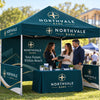
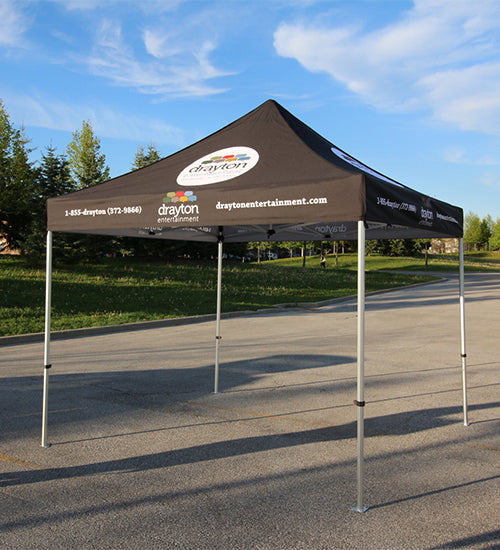
Branded canopies and tables - Outdoors, your shelter can be your biggest sign. A printed custom canopy and a matching table cover mark your space from across a field.
Outdoor Event Signage Ideas
Outdoor sites are bigger, windier and brighter than indoor halls, and guests are spread out. Good outdoor event signage ideas start with the site. Check the wind, the ground surface, the sun and how far away people will be. Then pick the signs that fit.
-
Parking signs: Use them wherever cars and people on foot share the site, so traffic keeps moving before guests reach the gate.
-
Entrance signs: Use them when a site has more than one way in, so guests head to the right gate.
-
Wayfinding signs: Use them on spread-out sites where no one can see the whole layout from one spot.
-
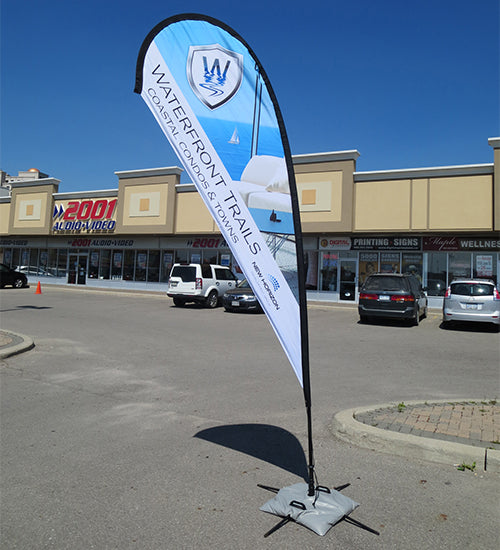
Custom flags: Use tall feather flags on wide or multi-zone sites. Guests can find a flag from far away and walk toward it.
-
Canopy branding: Use a printed canopy as the landmark for your booth, check-in or first-aid point.
-
Fence banners: Use them when the event has temporary fencing. A plain barrier becomes space for your brand or your sponsors.
-
Queue signs: Use them wherever lines form, such as entrances, food vendors and popular attractions.
-
Food and vendor signs: Use them at larger events, so guests can find a vendor or a dietary option without wandering.
-
VIP entrance signs: Use them when you sell tiered tickets, so premium and general guests don't crowd the same gate.
-
Exit and emergency signs: Use them at every event. Guests must be able to find the way out without asking staff. Follow the venue's and local safety rules for these.
Event Signage Materials Compared
The right material depends on where the sign will stand and how long it has to last. Use this table to narrow your choices.
|
Material |
Indoor |
Outdoor |
Best for |
Keep in mind |
|
Vinyl banner |
Yes |
Yes |
Entrance and sponsor banners |
Solid vinyl catches wind, so fix it firmly |
|
Mesh vinyl |
Yes |
Yes |
Fence banners and windy sites |
Lets air pass through; colors look a little lighter |
|
Polyester fabric |
Yes |
Yes, for flags and canopies |
Flags, canopies, backdrops, table covers |
Light backdrop frames need weights or shelter outside |
|
Corrugated plastic (Coroplast) |
Yes |
Short term |
Parking, yard and directional signs |
Very light, so strong wind can bend or move it |
|
Foam board |
Yes |
No |
Easel signs, schedules, room labels |
Moisture ruins it and the edges dent easily |
|
PVC board |
Yes |
Limited |
Rigid information and sponsor boards |
Can warp in heat and direct sun |
|
Aluminum composite |
Yes |
Yes |
Signs you will reuse for many events |
Heavier and costs more than plastic boards |
|
Floor vinyl |
Yes |
Limited |
Floor arrows and queue markers |
Needs a clean, smooth floor, a non-slip finish and venue approval |
Event Directional Signage Ideas
A directional sign answers one question: "Where do I go next?" These event directional signage ideas cover the spots where guests most often get stuck.
-
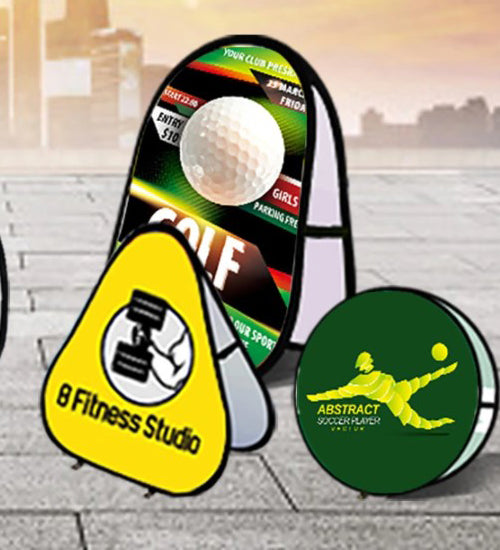
Decision-point arrows – Place a high-contrast arrow sign wherever a path or hallway splits. Portable A-frame signs work well, because you can set them down right at the turn.
-
Session room labels – Put a clear sign over or beside each door at events with several sessions running at once. Guests can check the room without opening the door.
-
Floor graphics – Use floor arrows or footprints in busy areas to lead people along a route or mark where a line starts.
-
Route signs – Cover each handoff along the way: parking to entrance, entrance to registration, registration to the main event, main event to restrooms and food, and exit back to parking.
Make Directional Signs Easy to Scan
People read directional signs while walking, so keep them simple. Use a few short words, large text, a clear arrow and strong contrast between the text and the background. Use the same symbols and the same place names on every sign.
Create a Consistent Wayfinding System
One arrow is rarely enough. At a large event, a guest may pass five signs between the parking lot and the main stage. If one says "Check-In," the next says "Registration" and a third says "Welcome Desk," people stop trusting the signs.
Wayfinding should feel like one system, not a pile of unrelated signs. Keep these the same from the first sign to the last:
-
Colors
-
Arrow style
-
Symbols
-
Place names
-
Fonts
-
Sign height and position
Match Signage to Viewing Distance
A sign read from three feet away needs a different design than one read from across a parking lot. Decide where the reader will be standing, then decide what goes on the sign.
|
Viewing distance |
What the sign should carry |
|
Close range |
Details, product information, registration steps, QR codes |
|
Medium range |
Booth or area name, brand message, a short offer |
|
Long range |
Brand or event name, a large arrow, one simple message |
Common Event Signage Mistakes
Most signage problems come from a few repeat mistakes. Check your plan against this list before you print anything.
-
Too much text — People walking past won't stop to read a paragraph.
-
Weak contrast — Light text on a light background is hard to read, and glare makes it worse.
-
Changing names — Calling one place by three names sends people in circles.
-
Poor placement — A sign is useless if guests see it only after they have passed the turn.
-
Branding over navigation — A big logo should never crowd out the arrow.
-
Too many signs — More signs can mean more noise, not better directions.
-
No sign at decision points — Put a sign wherever a guest must choose which way to go.
-
Ignoring outdoor conditions — Wind, soft ground and sun can knock down or wash out a sign that looks fine indoors.
Event Signage Planning Checklist
Use this list from the first plan to the final walk-through. Go through it once while you plan, and again after setup.
-
Define the event goal
-
Map the attendee journey
-
Mark the key decision points
-
Mark entrances and exits
-
Mark registration and activity areas
-
Choose one main brand message
-
Choose your signage types
-
List indoor and outdoor needs
-
Think about viewing distance
-
Keep directional messages short
-
Keep branding consistent
-
Check venue restrictions
-
Plan setup and transport
-
Walk the route as a guest would
-
Remove signs that repeat or add nothing
Build an Event Display That Helps People See, Navigate & Engage
Good event signage does more than make an event look branded. It helps people recognize you, understand what is happening, find where they need to go, and move through the day with less confusion.
The strongest setups treat every piece as part of one system: directional signs, a branded canopy, flags and table covers that all share the same look. Before you order, think about your event type, your branding goals, your indoor or outdoor setting, how guests will move, the space you have and how quickly you need to set up. Then talk to the Express Canopy team about turning your event signage ideas into a display that works together.
FAQ
What are good event signage ideas?
Start with a branded entrance sign, a backdrop at registration, tall flags or banners for visibility, and directional signs at every point where guests must choose a path. Add branded canopies and table covers so the whole space looks like one event.
Where should directional signs be placed?
Place them just before each decision point, such as a fork in a path, a doorway or the exit from a parking lot. Guests need to see the sign before they choose, not after. Set it above head height or in a clear gap, so a crowd can't hide it.
How do you make event signage easy to read?
Use few words, large text and strong contrast. Give each sign one message. Then test it by standing at the real viewing distance and reading it in about the time a guest would take to walk past.
What should I consider when choosing outdoor event signage?
Look at wind, ground surface, sun, expected weather and how far away people will be. Pick a base and weights that suit the surface. Ask the venue about its rules for stakes, weights and sign height, because these vary from site to site.
How many signs does an event need?
There is no set number. Count your decision points and key areas instead. Each one needs a sign, and each sign needs a reason to be there. If two signs say the same thing in the same spot, remove one.
Should directional signs carry my branding?
Yes, lightly. Use your brand colors and a small logo so the signs look like part of your event. Keep the arrow and the place name as the largest things on the sign.
How can signage improve the attendee experience?
It removes guesswork. Guests find parking, registration, sessions and restrooms without asking for help. They spend less time lost and more time taking part.