 UPLOAD FILES
Canopy Ideas: Build a Versatile Setup for Markets, Festivals & Events
The best canopy ideas are those that answer one common question the moment they are looked at.
What does this setup need to do at this event?
If you are hosting a Saturday market, or in a crowded festival, this question should answer the audience with ideas you have applied for marketing your business.
Most teams buy a canopy for shade and discover the other jobs on the day. Wind picks up, the booth next door is louder, and visitors walk past a plain roof without slowing down.
This guide is a collection of the outdoor canopy ideas that top marketers use to solve those problems. It covers layout, weather, visibility and setup. You will learn what to do, why it works and what it costs you in time or weight.
The stakes are real. Live events remain a priority channel: Bizzabo's 2026 benchmark found 78% of organizers rank in-person events as their most impactful marketing channel. When the event is the channel, the booth is the ad.
Start with the job: match the canopy to the event
Pick the setup by event type first, then by look. A canopy that suits a weekly market can be the wrong choice for a three-day festival on open grass. Therefore pick the setup first based on event type.
What to look for in the frame and fabric. Aluminum frames resist rust and are lighter to carry, which matters when you set up every week. Leg profile is the simplest strength signal: thicker legs flex less in wind and under hanging displays. Express Canopy's custom canopies come on 40 mm (1.25") or 50 mm (2") hexagonal aluminum frames, with dye-sublimated 600D polyester tops that are fire retardant, water resistant and UV coated. Choose 40 mm for lighter, occasional use and 50 mm for frequent use, larger footprints or windier sites.
10 outdoor canopy ideas for markets, festivals and promotions
These outdoor canopy ideas are modular. Start with one or two and add more as your event calendar grows.
-
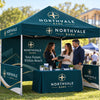
The open-front market stall. Leave the front fully open, add a back wall and keep the table set back 2-3 feet. Visitors can step under the shade without feeling committed to a conversation.
-
The convertible booth. Carry full walls, half walls and a door panel. Use half walls on calm days and full walls when rain or wind arrives, without changing the frame.
-
The L-shaped corner. On a corner pitch, open two sides and run tables in an L. You get two approach paths and more frontage from the same 10' x 10'.
-
The double bay. Join two 10' x 10' units or step up to a 10' x 20'. Use one half for display and one for transactions or demos, so queues don't block browsers.
-
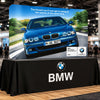
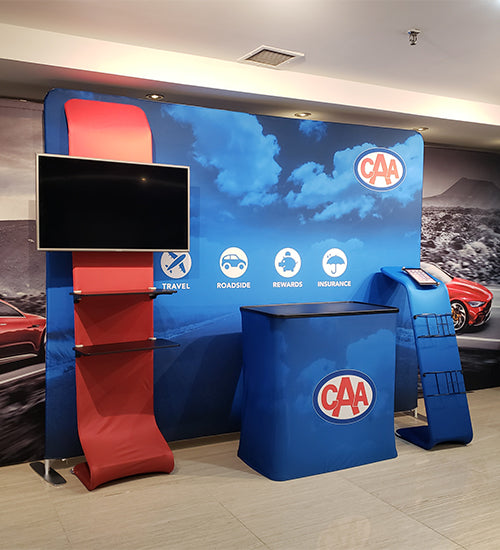
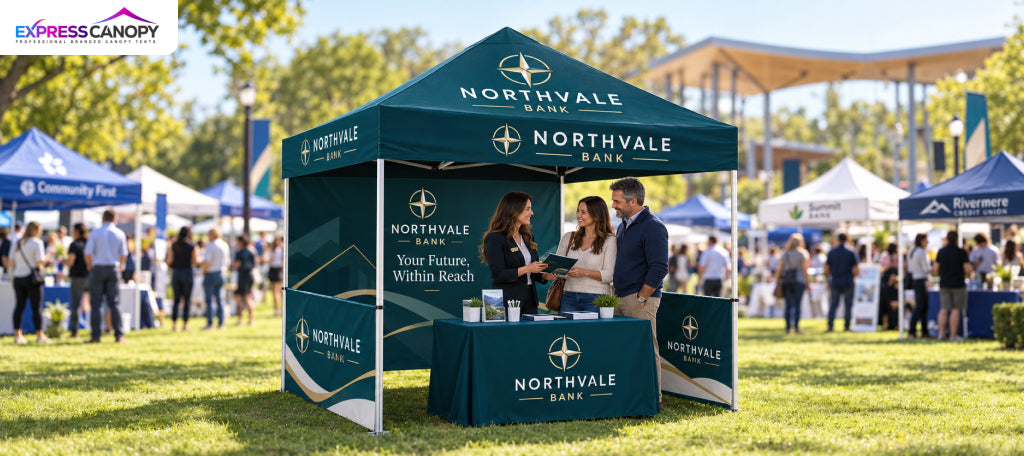
The branded back wall. If you print one thing beyond the roof, print the back wall. It sits behind your staff and products in nearly every photo visitors take.
-
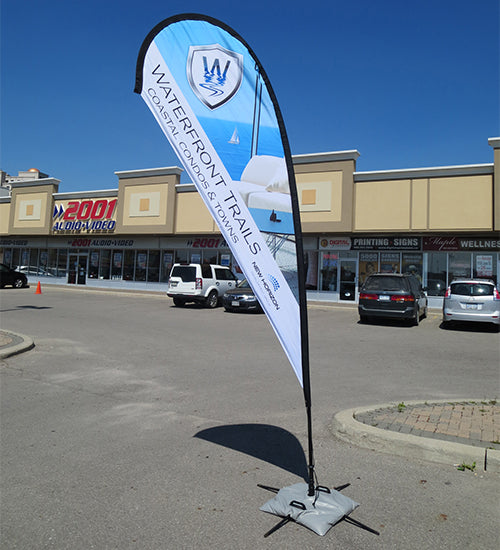
The flag beacon. A feather or teardrop flag at the front corner adds height and movement. It helps people find you across a field where every roof looks similar.
-
The lounge zone. For activations, give part of the space to seating. Shade plus somewhere to sit turns a walk-past into a ten-minute stay.
-
The demo stage. Raise one product on a stand or riser at eye level under the canopy centre.
-
The evening setup. Add battery-powered lighting so the booth stays readable after sunset, when many festivals do their best trade. Check the organizer's rules on power first.
-
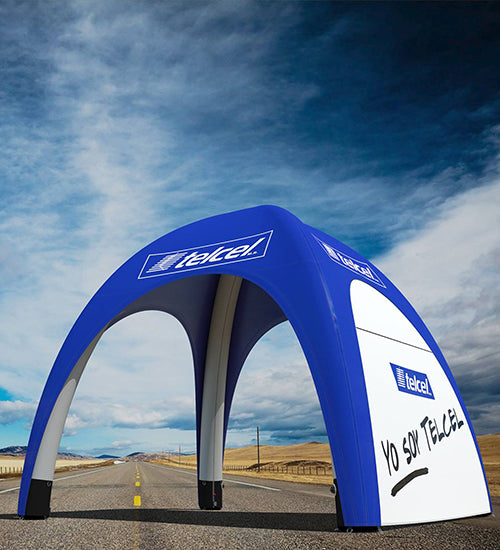
The hero structure. For large sponsorships, an inflatable tent or an inflatable arch at the entrance creates a silhouette where square roofs can't. Pair it with standard canopies for storage or staff areas.
Outdoor shade canopy ideas for comfort and changing weather
Comfort keeps people in your space longer, and weather is the risk that ends the day early. These outdoor shade canopy ideas address both.
Plan for the sun's path
Morning and afternoon sun comes in low and under the roof. A half wall or full wall on the sun-facing side extends useful shade far more than a bigger roof does.
Pick fabric for the conditions you face
Look for UV-protected, waterproof fabric. Lighter colors reflect more heat; darker roofs show branding with stronger contrast. Choose by climate and purpose rather than trend.
Weight every leg, every time
Wind is the leading hazard with pop-up canopies. Virginia State University Extension calls windblown canopies the top cause of property loss and injury at outdoor events where canopies are common. Practical benchmarks:
-
40 lb per leg for a 10' x 10' is a common market minimum. Larimer County Farmers' Market, for example, requires 40 pounds per leg and will ask vendors without it to take tents down.
-
Larger frames need more. UC Irvine's safety guide advises doubling the weight per leg for canopies larger than 10' x 10'.
-
Attach weights to the frame, not beside it. The same guide recommends strapping weights to each leg and tethering them to the top corner.
-
Know when to stop. Guidance varies by manufacturer, but many put the take-down point around 25–30 mph. Remove sidewalls first; walls act like sails.
Canopy design ideas that earn attention, honestly
Good canopy design ideas work with how people scan a busy space: they notice size, contrast and movement first, then read. The aim is to make your booth easy to notice, understand and approach, not to trick anyone into stopping.
Build a three-level visual hierarchy.
-
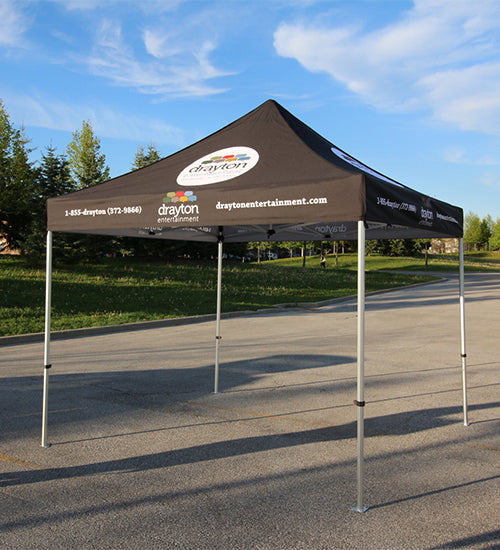
Level 1, seen from a distance: your logo or name on the roof valance, large and high. This is what people use to find you.
-
Level 2, seen on approach: one line on the back wall that says what you offer ("Small-batch coffee", "Free solar assessments").
-
Level 3, read up close: prices, QR codes and details at table height.
When all three compete at the same size, none of them reads.
Use contrast, not just color
A light logo on a dark roof, or the reverse, reads further than two mid-tones. For on-screen text the W3C's WCAG guideline sets a 4.5:1 minimum contrast ratio; that isn't a signage standard, but it's a useful test for any printed text.
Keep the brand consistent
Match roof, walls, flags and table covers to the same Pantone references so a multi-unit setup reads as one brand. Repeated, consistent cues are what make a brand recognizable at the next event.
Reduce decision friction
Visitors decide in moments whether to step in.
-
Show one clear offer or call to action, not five.
-
Display prices; hidden prices make people hesitate.
-
Leave a visible, open entry point. A table across the full front reads as a barrier.
-
Group products into a few clear categories so choosing feels easy.
Keep it ethical
No fake scarcity, no misleading claims on banners and no imagery you don't have the rights to use. Trust is the outcome you're designing for: Cvent reports that over 90% of attendees whose trust in a brand rose after an event went on to buy.
Making a small footprint work harder
Most market and festival pitches are 10' x 10', so space utilization decides how much you can show and how many people you serve at once. These are the principles that carry across event types; for a full walkthrough of booth layouts, see our 10x10 vendor booth ideas.
-
Go vertical
Shelving, grid walls and hanging displays use height the floor can't give you. A frame with extra-height legs adds headroom for tall displays and taller visitors.
-
Split front and back
Keep the front third for browsing and the back for stock, payment and staff. Visitors shouldn't have to walk past your boxes.
-
Use walls as display surfaces
A printed or plain sidewall can hold signage, price lists or product imagery while also blocking wind.
-
Store under covered tables
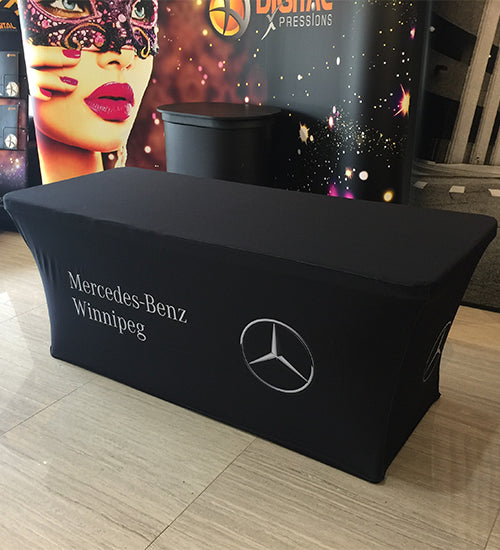
A fitted table cover hides spare stock and bags and keeps the front clean.
-
Leave a standing pocket
Even 3 feet of clear space inside the canopy lets two or three people stop without blocking the aisle.
-
Plan the queue
If you sell or sample, decide where the line forms before the doors open. A line that spills sideways into a neighbor's pitch causes friction with organizers.
Setup, transport and compliance
A versatile setup is one your team can put up the same way every time. Plan the logistics before you plan the look.
Know what you're carrying
A 10' x 10' printed top on an aluminum frame ships at around 51 lb before walls or weights, per Express Canopy's starter package specs. Add 160 lb or more of leg weight for a 10' x 10' and you need a cart, not just a car boot.
Use two people for setup
Pop-up frames are designed for quick assembly, but raising one alone in wind risks bent trusses and injuries. Keep the setup instruction sheet with the kit so new staff follow the same steps.
Read the vendor packet early
Organizers commonly set rules on:
-
Minimum weight per leg and whether staking is allowed
-
Flame-resistance certification for fabric (CPAI-84 is a frequent requirement; Express Canopy tops carry a CPAI-84 certificate)
-
Footprint limits, including flags, A-frames and anything that overhangs the pitch
-
Power, generators and lighting
-
Overnight setup and wind take-down policies
Build a repeatable kit list
Pack walls, weights, straps, flags and table covers in the same bags every time. Replacement parts and anchoring kit are available under canopy tent hardware and accessories.
Build once, adapt every season
The most useful canopy ideas aren't one-off looks. They're a core kit that adapts: a strong frame, a clear brand, walls for the weather and add-ons you bring when the event calls for them.
If you're planning for next season, start with the checklist above and your event calendar. When you're ready to explore options, browse our custom canopies or talk to a team member about the events you attend. Our designers can mock up your artwork free and send a proof before anything is printed.
FAQ
What are the most versatile canopy ideas for businesses that attend different events?
Start with a 10' x 10' on a sturdy aluminum frame, a printed roof and a set of interchangeable walls. Add a flag and a table cover. That one kit adapts to markets, festivals and community events, and you can add a second unit or an inflatable for larger activations.
How much weight does a canopy need at a market or festival?
A common minimum is 40 lb per leg for a 10' x 10'. Larger canopies need more, often double per leg. Always follow the organizer's rules if they're stricter.
When should I take my canopy down in wind?
Remove sidewalls first as gusts rise. Many manufacturers advise taking pop-up canopies down at roughly 25–30 mph, even when properly weighted.
What canopy design ideas help a booth stand out without looking cluttered?
Put your name large on the roof valance, one short offer line on the back wall and details at table height. Use strong light–dark contrast and keep colors consistent across every piece.
Which outdoor shade canopy ideas keep visitors comfortable?
Add a wall on the sun-facing side, leave a shaded standing pocket inside the canopy and offer seating at longer events. Lighter roof colors reflect more heat.
Do event organizers require flame-resistant canopies?
Many do, especially at larger events and public venues. CPAI-84 certification is a common requirement. Bring the certificate with you.