 UPLOAD FILES
Commercial vs Consumer Canopy Tents: Which One Is Right for Your Business?
A vendor at a busy Saturday market unboxed a canopy she'd grabbed from a big-box store the night before the kind marketed for backyard barbecues and camping trips. By noon, the frame was already bowing under a light breeze. By two, a seam had torn loose and she was holding a corner pole by hand just to keep her table dry. She sold half of what she normally would, and the tent never made it to the next event.
That's the gap between a tent built for a backyard and one built for business. It's not always obvious from a product photo. Both look like a canopy, fold up, and have a logo space. But when you're setting up week after week, in wind, sun, and rain, the difference between a commercial canopy tent and a consumer canopy tent shows up fast. This guide breaks down exactly what separates the two, so you're not the vendor holding a pole by hand.
The Short Answer
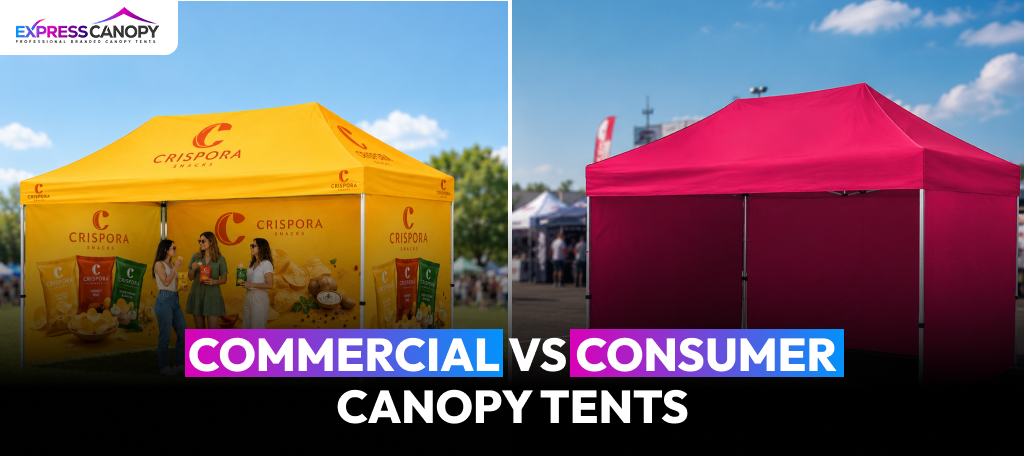
The core difference in commercial vs consumer canopy tents comes down to materials, frame strength, and how many times the tent is designed to be set up. A consumer canopy tent is built for occasional personal use like camping trips, backyard parties with lighter frames and fabric.
A commercial canopy tent is engineered for repeated professional use, with heavier-gauge steel or aluminum frames and industrial-grade fabric that holds up to weekly setup, branding, and outdoor exposure. If your tent represents your business, commercial-grade is almost always the better investment.
What Actually Separates the Two
Before comparing them side by side, it helps to know what's really different under the surface:
-
Frame material and thickness
Consumer frames use thinner tubing; commercial frames use heavier steel or aluminum built to flex and recover, not bend and stay bent
-
Fabric weight and coating
Commercial canopies typically use denser, UV- and water-treated fabric rated for far more sun exposure
-
Hardware quality
Stronger hinges, thicker connectors, and reinforced corners on business-grade tents
-
Print durability
A commercial canopy tent with logo printing is built to keep colors sharp after dozens of setups, not fade after a few
-
Warranty and lifespan
Commercial tents are made to last years of regular use; consumer tents are made to last a season or two of occasional use
Commercial vs Consumer, Side by Side
|
Feature |
Consumer Canopy Tent |
Commercial Canopy Tent |
|
Frame |
Lightweight aluminum/steel |
Heavy-duty steel or aircraft aluminum |
|
Fabric |
Standard polyester |
Industrial, UV/water-treated fabric |
|
Branding |
Limited or none |
Full custom logo printing available |
|
Best For |
Camping, backyard use |
Trade shows, vendor markets, business events |
|
Lifespan |
1-2 seasons of light use |
Multiple years of weekly use |
|
Price |
Lower upfront cost |
Higher upfront, lower cost per use over time |
Weighing the Trade-Offs
Consumer Canopy Tent
-
Pros: lower upfront price, lightweight, easy for occasional personal use
-
Cons: weaker frame, less wind resistance, fabric fades faster, rarely supports quality branding
-
Best use case: weekend camping trips, backyard parties, one-off personal outdoor use
Commercial Canopy Tent
-
Pros: built for repeated setup, stronger in wind and weather, holds branded printing well, longer usable lifespan
-
Cons: higher upfront cost, heavier to transport
-
Best use case: trade shows, vendor markets, corporate events, any setting where the tent represents your business
Where a Heavy Duty Canopy Tent Actually Earns Its Keep
If you're setting up outdoors more than a couple of times a year, a heavy duty canopy tent stops being a luxury and starts being basic equipment. Vendors running weekend markets need a frame that survives dozens of setups without loosening at the joints.
Businesses doing trade show canopy tent activations need something that looks sharp on day one and still looks sharp on day fifty. And anyone printing a commercial canopy tent with logo graphics wants fabric that won't fade or crack after a few washes and a few sunny afternoons. Browse Heavy Duty Canopy Tents built specifically for that kind of repeat use.
Choosing the Right Setup for How You Actually Use It
Not every business needs the same tent, but a few patterns hold true:
-
Frequent outdoor vendors look at a Commercial Canopy Tent with a reinforced frame rated for weekly setup and breakdown
-
Trade show and expo teams a Professional Canopy Tent with clean branding space makes the biggest visual impact
-
Businesses building a mobile setup – a Pop Up Canopy Tent that sets up fast without sacrificing durability
-
Anyone printing their branding on-site – a Custom Canopy Tent with logo printing keeps your brand sharp and consistent
-
Teams needing extra stability outdoors – round out the setup with Canopy Tent Accessories like weights and sidewalls
Common Missteps When Choosing a Canopy Tent
-
Buying a consumer-grade tent because of price, then replacing it twice in a season
-
Skipping wind-rated frames for events with open, exposed setups
-
Choosing thin fabric that fades a logo within a few uses
-
Not accounting for how often the tent will actually be set up and packed down
-
Overlooking accessories like weights and sidewalls that extend the tent's usable life
Quick Decision Checklist
✓ How often will this tent be set up per month?
✓ Will it need to survive wind, rain, or full sun regularly?
✓ Does it need to carry printed branding?
✓ Is it representing your business at trade shows or vendor markets?
✓ Do you need a frame rated for years of use, not just a season?
If you answered yes to most of these, a commercial or business canopy tent is the smarter long-term choice.
What Most Comparisons Leave Out
The frame-and-fabric explanation is the version everyone gives. Underneath it, though, there are a handful of specific engineering and legal differences that actually decide whether a tent survives a season or gets you turned away from an event entirely.
-
Wall thickness, not just material
A heavy-duty aluminum leg typically runs around 2mm of wall thickness, while a budget steel leg is closer to 1mm. Two frames can look identical in a photo and still be built from tubing that's half as strong.
-
Leg diameter
Steel-leg tents commonly use a 1-inch leg profile; commercial aluminum frames use a 2-inch profile. More diameter means more resistance to bending under wind load.
-
Footpad thickness
An easy detail to miss, but the footpads carry the full weight of the frame, often 60-70 lbs on a 10x10 high-wind design. Budget tents use footpads around ⅛ inch thick; commercial frames use closer to ¼ inch.
-
Joint hardware
Consumer tents often rely on plastic or basic aluminum connectors at the joints. Commercial frames use anodized aluminum joints specifically because that's where the most stress and friction concentrate and where cheaper tents crack first.
-
Fabric denier
Rather than "thicker fabric," commercial-grade material is typically rated 300D-600D+, while consumer fabric runs 150D-300D. It's a measurable spec, not a marketing description.
-
A real wind rating gap
Properly specced commercial frames are generally rated for winds up to 35+ mph. Consumer-grade frames commonly start failing above 20 mph, regardless of how well they're staked down.
-
Fire certification is a legal distinction
Most consumer tents are only tested to CPAI-84, a camping-fabric flammability standard and a CPAI-84 label alone doesn't mean the fabric is flame retardant or safe near heat.
Business use at public events typically requires NFPA 701 certification instead. Show up without it, and a fire inspector can require the tent be removed on the spot.
-
Certification connects directly to permits and insurance
Many municipalities require proof of flame resistance before issuing a tent or vendor permit, and most events separately require proof of general liability insurance before a vendor is allowed to set up. Consumer tents were never built with either requirement in mind.
-
The price gap is a different cost category
A 10x10 steel-frame tent with custom printing typically runs in the $400-$700 range, while a comparable 10x10 commercial aluminum frame runs $900-$2,900+. That's not a small upgrade, it's a different product tier.
-
Corrosion resistance over time
Steel frames are prone to rust, even coated, especially in humid or coastal climates, and need regular upkeep to stay functional. Aluminum resists corrosion in virtually any environment without that maintenance.
Final Thoughts
The choice between commercial and consumer canopy tents really comes down to how often your business shows up outdoors, and what's riding on that setup looking sharp every time. A consumer tent might get you through one weekend. A commercial one is built to get you through years of them. If your canopy is doing double duty as a booth, a billboard, and a first impression, it's worth outfitting it properly, from the frame to the fabric to the finishing touches like Custom Canopy Tents with logo printing.
FAQs
1. What's the main difference between commercial and consumer canopy tents?
Commercial tents use heavier frames and industrial-grade fabric built for repeated professional use, while consumer tents are lighter and designed for occasional personal use.
2. Is a commercial canopy tent worth the extra cost?
For anyone using it regularly, vendors, trade show teams, businesses, yes. The lower cost-per-use over its longer lifespan typically outweighs the higher upfront price.
3. Can I put my logo on a consumer canopy tent?
Technically yes, but the fabric usually isn't built to hold sharp printed graphics as well or as long as commercial-grade material.
4. What size canopy tent works best for trade shows?
10x10 is the most common trade show canopy tent size, though larger footprints are available for bigger booths or higher-traffic events.
5. How much wind can a heavy duty canopy tent handle?
It varies by model, but commercial frames paired with proper weights are generally rated for significantly higher wind resistance than consumer-grade frames.
6. Are commercial pop up canopy tents hard to set up?
No, most commercial pop-up designs are built for fast, one- or two-person setup despite their heavier-duty construction.
7. What's the best canopy tent for vendors who set up weekly?
A commercial or heavy-duty canopy tent with a reinforced frame is the better choice, since it's built to withstand frequent assembly and breakdown.
8. Do commercial canopy tents come with a warranty?
Most do, and warranty length is often a useful signal of how confident the manufacturer is in the tent's durability.
9. Can a consumer canopy tent be upgraded with accessories?
To some extent, weights and sidewalls help but accessories can't fully compensate for a lighter-weight frame or fabric.
10. How do I know if I need a professional canopy tent for my business?
If the tent represents your brand in public more than a few times a year, a professional-grade setup is almost always the right call.