 UPLOAD FILES
Commercial Tents and Canopies: Choosing the Right Setup for Your Business
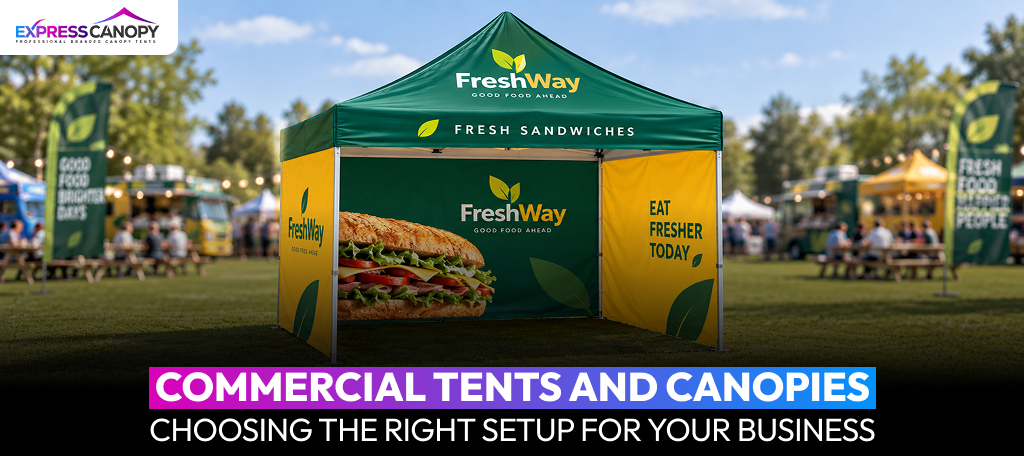
The best commercial tents and canopies are selected around how your business actually operates at events. Consider how often you attend, how many people work under the canopy, what customers do when they arrive, how much equipment you bring, and how much branding you need.
A farmers market seller may prioritize open access and merchandise space, while a corporate activation may need branded walls, a presentation area, and room for conversations. Choosing around these functions helps you invest in event space your team can actually use.
What Makes a Tent or Canopy Commercial-Ready?
Commercial use typically means repeated transportation, setup, breakdown, storage, and exposure to different event environments. That changes the buying criteria.
Evaluate:
-
Frame and canopy materials
-
Frequency of use
-
Setup and breakdown requirements
-
Packed transportation needs
-
Available event footprint
-
Graphic customization
-
Wall configurations
-
Replacement parts and accessories
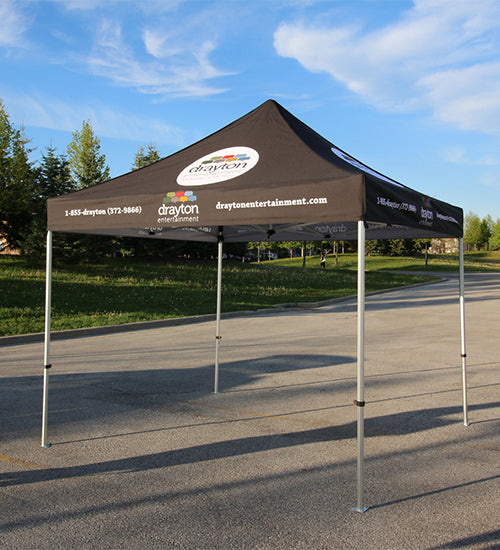
Express Canopy's custom canopy tent collection includes 10x10, 10x15, and 10x20 configurations with 40 mm and 50 mm hexagonal aluminum frame options. Its printed tops use dye-sublimation graphics on 600D polyester fabric.
The useful question is therefore not simply, “Is this a commercial canopy tent?” It is, “Does this configuration fit how my team works?”
Match the Canopy Configuration to the Business
Different commercial environments require different layouts.
|
Business Use |
Priority |
Practical Configuration |
|
Farmers market |
Customer access + products |
Open front with rear/side branding |
|
Trade show |
Brand visibility + presentation |
Printed canopy with graphic wall |
|
Corporate event |
Interaction + seating |
Larger zoned configuration |
|
Sporting event |
Registration + sponsor exposure |
Open-front branded canopy |
|
Product activation |
Demo + interaction |
10x15 or 10x20 zoned layout |
|
Festival vendor |
Service + covered workspace |
Canopy with selective walls |
A farmers market booth, for example, benefits from an open entrance because customers need to browse quickly.
A product launch needs a different flow. One section can attract visitors, another can host demonstrations, and a third can handle lead capture.
For corporate hospitality, seating consumes more floor area. Moving from a compact booth to a larger configuration can therefore become a functional decision rather than simply a visual upgrade.
Choose Size by Activities, Not Attendance
Do not choose a commercial tent canopy solely by how many people you expect at the event. Most visitors will not occupy the booth simultaneously.
Instead, calculate what must remain underneath it.
10x10: One Primary Activity
A 10x10 custom canopy works for registration, compact retail, information stations, sampling, and vendor booths where the business performs one main customer-facing activity.
10x15: Add a Second Function
A 10x15 canopy configuration provides more room for businesses combining product presentation with consultation, checkout, demonstrations, or additional inventory.
10x20: Build Multiple Zones
A 10x20 custom canopy provides a 200-square-foot footprint. That allows businesses to separate activities instead of forcing everything into one customer area.
A useful layout could be:
Attract → Demonstrate → Convert
Use the first zone for products or messaging, the middle for interaction, and the final section for orders, consultations, or lead capture.
Decide How Open the Canopy Should Be
Walls should solve a specific business requirement.
An open commercial canopy tent supports multidirectional traffic at festivals and markets. A rear wall creates a branded background while keeping customer access open. Adding one sidewall can separate inventory or equipment from the visitor area.
Half walls are useful when you want to establish a boundary without fully enclosing the booth.
Express Canopy's printed canopy walls and accessories include full and half-wall options for common 10x10, 10x15, and 10x20 configurations.
Avoid adding walls simply because they are available. Consider customer approach direction, neighboring booths, sun exposure, operational privacy, and venue requirements first.
Turn the Canopy Into the Brand Environment
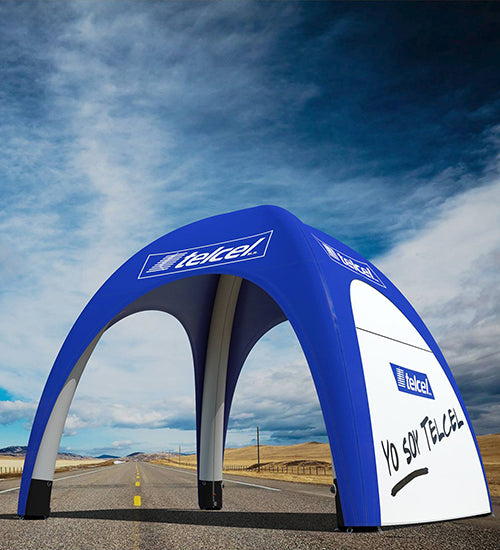
Custom graphics allow the structure itself to perform much of the visual work.
Think about branding by viewing distance.
-
Roof: Recognition from farther across the event.
-
Valance: Company name or short message as visitors approach.
-
Sidewall: Product imagery or supporting information.
-
Rear wall: Primary campaign visual or presentation background.
This approach can reduce dependence on separate floor-standing signs while preserving space for products and people.
Keep important messaging short enough to understand while walking. Detailed product information belongs inside the booth, where interested visitors can engage with it.
Plan for the Team Behind the Booth
One purchasing consideration is frequently overlooked: what happens before and after the public sees the tent?
Your team still has to transport, unload, assemble, operate, dismantle, and store it.
Before purchasing commercial outdoor tents, map the complete operating cycle:
Storage → Vehicle → Venue → Setup → Event → Breakdown → Vehicle → Storage
A larger configuration may provide useful customer space, but it also means handling additional components.
Express Canopy's canopy hardware collection includes frames, wheel bags, bases, stakes and ropes, frame connectors, and half-wall support bars.
Consider these requirements when planning the complete setup rather than treating accessories as an afterthought.
Build Around How Your Business Actually Sells
The strongest commercial tents and canopies support the way customers interact with your business.
Start with four questions:
-
What will customers do under the canopy?
-
What does your staff need to operate efficiently?
-
Which areas should remain open, branded, or separated?
-
How will your team transport and manage the complete setup?
Then choose the size, walls, graphics, furniture, and accessories around those answers.
Explore our custom canopy options to build an event setup around your available space, branding, staff workflow, and customer experience.
How do I know whether my business needs a 10x10, 10x15, or 10x20 canopy?
Start with the activities that must happen under the tent. A 10x10 works for one primary function, while 10x15 and 10x20 setups are more suitable when you need separate areas for products, staff, demonstrations, storage, or customer conversations.
Should a commercial canopy have full sidewalls or stay mostly open?
That depends on traffic flow and how the booth is used. Open sides work well for markets and festivals, while a rear wall or selective sidewalls can support branding, privacy, inventory separation, or directional protection without fully enclosing the space.
What should frequent event exhibitors prioritize when buying a commercial canopy?
Look at transport, setup time, packed components, frame options, graphic replacement needs, storage, and how easily your team can manage the complete system across repeated events.
Can the same commercial canopy setup work for different types of events?
Yes, if the configuration is flexible. A branded canopy with removable walls, adaptable furniture, and interchangeable accessories can be adjusted for farmers markets, corporate events, sports activations, retail promotions, and community events.
What is the biggest mistake businesses make when buying commercial tents and canopies?
Buying based only on dimensions or appearance. The more useful approach is to plan around customer movement, staff workflow, products, equipment, branding surfaces, venue limits, and transportation before choosing the final size and configuration.