
 UPLOAD FILES
Big Canopy Tent Ideas for Creating More Space at Outdoor Events
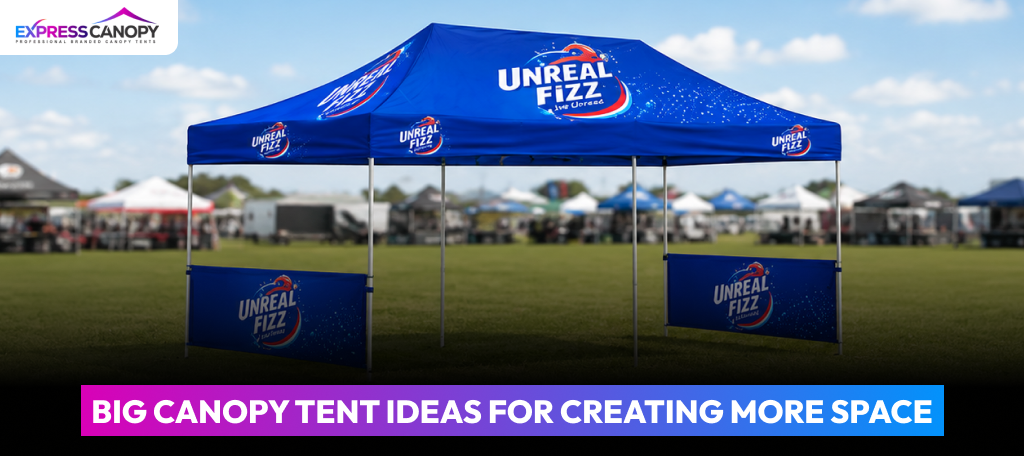
A big canopy tent creates more useful event space when its footprint is planned around people, products, staff, and movement, not simply filled with more furniture. For commercial events, the strongest layouts use open entrances, perimeter displays, defined activity zones, selective sidewalls, vertical branding, and concealed operational areas.
The result is a canopy that feels spacious while supporting more business activity within the same footprint.
Choose Space Based on What Happens Inside It
Start by identifying the functions the canopy must support.
A basic promotional booth may need a greeting point and information table. A product activation could require demonstration, consultation, storage, and visitor areas. A food business may need separate ordering, preparation, pickup, and supply zones.
That distinction helps determine whether a 10x10 custom canopy, 10x15 custom canopy, or 10x20 custom canopy fits the event.
|
Canopy Size |
Covered Footprint |
Useful Layout Strategy |
|
10x10 |
100 sq. ft. |
One primary customer activity |
|
10x15 |
150 sq. ft. |
Customer zone + secondary activity |
|
10x20 |
200 sq. ft. |
Multiple customer and operational zones |
The 10x20 format provides a 200-square-foot footprint, making it particularly useful when several functions need to operate under one canopy.
Try the “Empty Middle” Layout
One of the most effective ways to make a large canopy feel spacious is surprisingly simple: do not use the middle.
Move tables, displays, samples, and product racks toward the perimeter. Leave a continuous central route from the entrance toward the rear.
This creates longer sightlines. Visitors can see into the entire booth instead of encountering furniture immediately after entering.
For retail events, products can run along two sides with a featured item at the rear. For service businesses, consultation counters can sit along one side while the opposite side supports demonstrations.
Think of the center as circulation space rather than unused space.
Create a 70/30 Front-to-Back Split
A canopy tent large enough for commercial activations does not need to expose every operational detail.
Use roughly the front portion for visitors and reserve a smaller rear section for staff functions.
A printed full back wall does not always need to sit at the actual rear edge. Where the setup and event rules permit, your layout can visually separate customer-facing activity from operational items.
The front becomes the brand experience. The service area can handle spare stock, cases, employee belongings, packaging, and supplies.
Express Canopy offers printed canopy walls and accessories for 10x10, 10x15, and 10x20 configurations, including full and half walls.
This concept is particularly useful for food sampling, merchandise sales, registration points, and mobile marketing activations.
Build Two Mini Booths Inside a 10x20
A 10x20 big tent canopy does not have to function as one oversized room.
Create two connected 10-foot zones instead.
For example:
Zone A - Discover
Hero product, samples, interactive demonstration, or introductory messaging.
Zone B - Engage
Consultation, signup, ordering, lead capture, or hospitality.
Visitors move naturally from discovery to interaction.
A home-services company could display materials in the first zone and hold project consultations in the second. A beverage brand could offer samples on one side and merchandise or social engagement on the other.
This makes the additional footprint commercially productive instead of simply making the booth wider.
Use a Diagonal Layout to Create Visual Depth
Most outdoor booths arrange everything parallel to the tent legs. That creates predictable rectangular spaces.
Try introducing one diagonal element.
A product pedestal, demonstration counter, or small table positioned at an angle can direct visitors deeper into the space.
The technique works particularly well in a 10x15 configuration because the longer footprint already provides depth.
Avoid angling every component. One directional element is enough to influence movement while maintaining usable circulation.
Replace Front Tables With Side Counters
A table spanning the entrance consumes valuable frontage and encourages visitors to interact from the aisle instead of entering.
Move the table 90 degrees so it runs along the side.
This single change can transform how the booth functions. Visitors gain a wide entrance, staff can interact from inside the canopy, and the rear graphic becomes visible from farther away.
If a branded counter is needed, custom table covers can integrate the table into the visual identity without adding another freestanding sign.
Treat Sidewalls as Movable Space Dividers
Sidewalls should do more than surround the tent.
Use them strategically to control how visitors experience the space.
-
One rear wall: creates a visual destination.
-
Rear + one side: useful for corner locations or directional traffic.
-
Rear + half walls: defines boundaries while preserving visibility.
-
Open sides: supports multidirectional traffic at festivals and public events.
A wall should earn its position. If it does not support branding, privacy, weather management, storage, or visitor flow, leaving that side open may create a more spacious environment.
Move Branding Up Instead of Out
Floor-standing promotional materials compete with people for space.
A smarter approach is to use the canopy itself as the primary advertising surface.
Express Canopy’s custom canopy tents support printed tops and package configurations with printed walls and related branded components.
Use the roof for brand recognition, valances for short messaging, and the rear wall for the campaign story.
This creates a useful principle:
Brand vertically. Operate horizontally.
The more branding you move onto existing surfaces, the more floor area remains available for customers and activities.
Create a “No-Storage Floor”
Cases, cartons, packaging, unused chairs, and spare merchandise can quickly consume the extra room gained by buying a large outdoor canopy.
Create one operational rule: nothing is stored on the customer-facing floor unless it is part of the experience.
Use designated rear storage, under-table space, or an off-booth replenishment point when feasible.
This is especially valuable at farmers' markets and festivals where vendors often arrive with enough inventory for an entire day.
A well-planned 10x15 can provide more functional customer space than a poorly organized 10x20.
Create Modular Space for Changing Event Traffic
Outdoor traffic changes throughout the day.
Morning visitors may browse individually. Peak periods can bring groups. Later hours may require more conversation space.
Design the booth so components can adapt without rebuilding the entire setup.
Half walls can define sections without fully enclosing them. Smaller tables can be repositioned more easily than one oversized counter. For compatible configurations, canopy hardware and accessories include frame connectors, half-wall support bars, bases, stakes, ropes, and transport-related components.
Modularity gives the team more control over how the footprint functions throughout the event.
Real U.S. Commercial Use Cases
Different businesses should use additional space differently.
-
Farmers' markets: perimeter merchandise with a central browsing lane.
-
Food festivals: separate ordering and pickup points to reduce crossing traffic.
-
Sports events: registration at the front, participant support behind it.
-
Auto promotions: open central space for conversations with branding around the perimeter.
-
Community events: information zone plus a separate consultation area.
-
Product launches: discovery area followed by demonstration and lead capture.
-
University events: front-facing information with seating or registration deeper inside.
The strongest layout follows what visitors need to do next.
Think in Square Feet, Then Think in Flow
A big canopy tent should not simply hold more objects. It should allow the business to separate activities that compete for space in smaller booths.
A 10x15 configuration can provide enough additional depth for a secondary customer activity. A 10x20 can support multiple defined zones across its 200-square-foot footprint.
The final decision should come down to four questions:
-
How many activities need to happen simultaneously?
-
Where should visitors enter and exit?
-
Which items genuinely need to remain inside?
-
Which surfaces can perform two jobs?
Use the roof as advertising. Let walls provide branding and separation. Push furniture toward the perimeter. Hide operational supplies. Preserve sightlines. Give each zone one purpose.
That is how a large canopy tent becomes genuinely useful event space rather than simply a larger footprint.
FAQs Inspired by Real Buyer Questions
Should I buy a large canopy with sidewalls or without them?
Removable sidewalls give you more flexibility. You can keep the booth open during normal event hours, add one or two walls for sun or directional protection, and use more coverage when the event setup or weather requires it. Vendors frequently debate this exact issue because walls affect both protection and customer access.
Is a 10x20 canopy easy enough for a small team to set up?
That depends on the frame, packed components, and how often you move it. Buyers frequently ask about setup and breakdown time before investing in a larger configuration, especially when one or two people handle events.
Will event organizers allow a 10x20 canopy?
Do not assume they will. Some fairs and markets use standard 10x10 vendor spaces or impose specific requirements for tent type, anchoring, fire documentation, and overall footprint. Confirm your allocated space before purchasing a larger setup.
How much of a 10x20 canopy should be used for seating or displays?
Avoid filling the entire 200-square-foot footprint. Buyers using 10x20 spaces for overflow or hospitality often face the same problem: too much furniture reduces circulation quickly. Prioritize the main activity, then leave enough open space for people to move between zones.
Can I leave a large canopy set up overnight at a multi-day event?
That depends on the event rules, weather, anchoring requirements, and manufacturer guidance. Vendors at multi-day events commonly ask whether to lower or fully enclose their setup overnight, so this should be planned before the first event day rather than decided at closing time.