 UPLOAD FILES
Fitted vs. Stretch vs. Throw Table Covers: Which Style Is Right for Your Event?
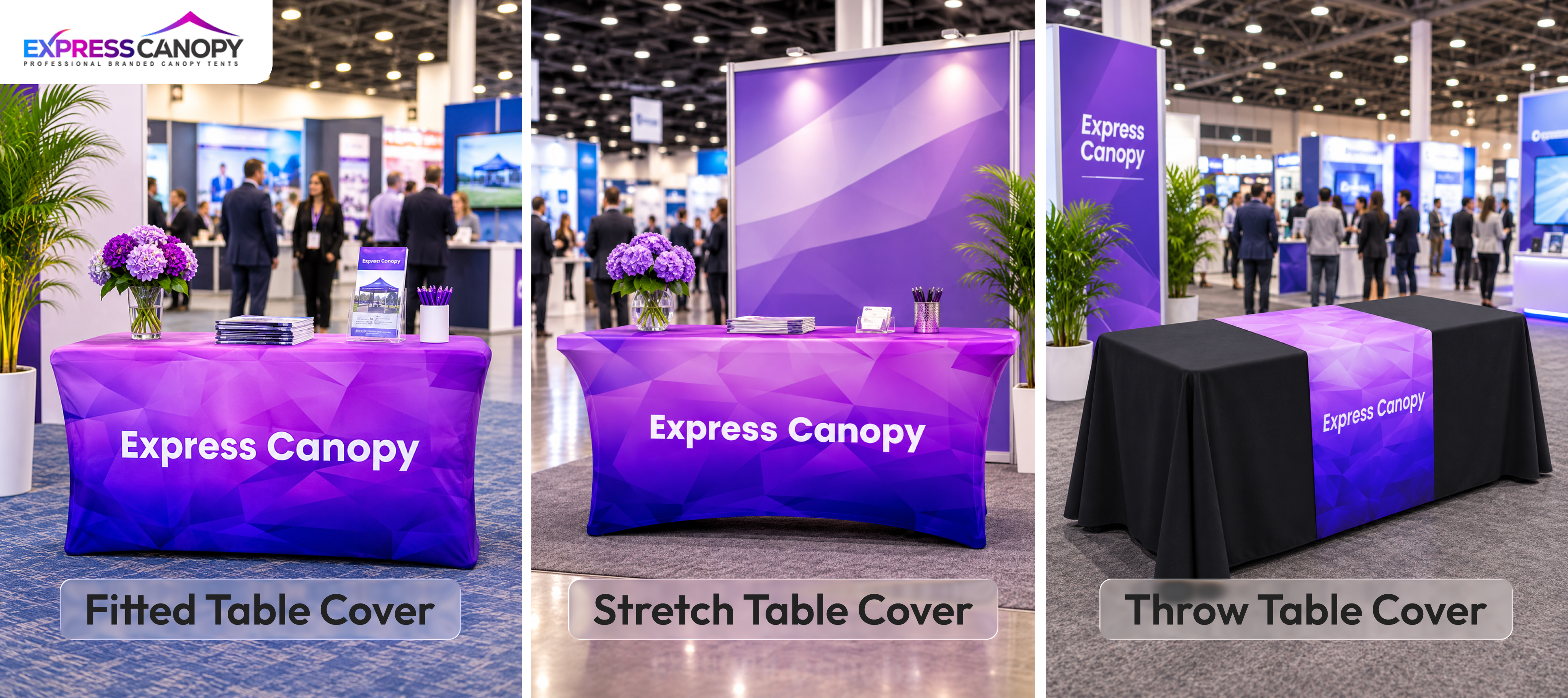
At first glance, fitted, stretch, and throw table covers may look like three versions of the same product. Each adds branding to a table, covers the surface, and gives an event display a more finished appearance. But their construction solves different problems. One creates a tailored, structured look, another uses tension to achieve a smooth silhouette and the third prioritizes flexibility and quick setup.
Choosing between them is less about finding the best table cover and more about deciding which trade-off works for your event. Table dimensions, indoor or outdoor conditions, storage needs, and how the display will appear in photographs all matter.
Let’s compare the three styles before ordering.
1. Fitted Table Covers: Best When Table Size Is Known
A fitted table cover is designed around specific table dimensions. Its tailored corners and sewn edges create a box-like shape that follows the tabletop and hangs neatly down the sides.
This structured finish makes fitted covers a dependable choice for trade shows, corporate events, registration desks, and branded presentation counters. The fabric stays aligned with the table rather than forming loose folds, which helps maintain a consistent appearance throughout the event.
Fitted covers are also useful when the table needs to remain accessible. Depending on the selected configuration, buyers can choose a four-sided cover, an open-back design, or a zippered option. An open back allows staff to reach stored materials, while a closed design conceals the space underneath.
The trade-off: Fitted covers require accurate measurements. A cover made for a 6ft table should not be assumed to fit every table described as 6ft, tabletop depth and height can differ.
Choose fitted if: You know your table dimensions, want a polished box-shaped appearance, and need a cover for a repeatable booth setup.
2. Stretch Table Covers: Best for a Sleek, Taut Finish
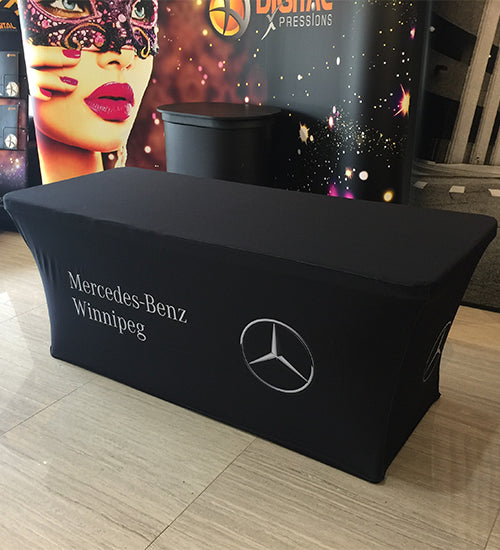
Stretch covers use elasticized fabric, commonly a spandex blend, that pulls tightly around the table. The material is secured around the legs, often with fitted pockets, creating a close-fitting silhouette without the loose drape of a traditional cover.
This tension is the main advantage. It reduces visible folds and excess fabric, making stretch covers particularly suitable for brands that want a contemporary presentation. They also tend to photograph cleanly because the front panel remains smooth when properly fitted.
The snug construction can help the cover stay in position in breezy outdoor settings better than a loose throw. However, it does not make the table or display windproof. Strong gusts can still move lightweight tables and equipment, so outdoor exhibitors should secure their setup separately.
Stretch covers are especially useful for promotional events, outdoor brand activations, and displays where the table will be photographed from several angles.
The trade-off: Stretch fabric needs the correct dimensions to achieve its intended tension. Too small, and installation becomes difficult; too large, and the material may not sit smoothly.
Choose stretch if: You want a modern, wrinkle-resistant appearance, a close fit, and better control over loose fabric.
3. Throw Table Covers: Best for Flexibility and Fast Setup
A throw cover uses a simple draped construction. It is placed over the tabletop, allowing the fabric to fall over the sides rather than following the table's shape closely.
Its biggest advantage is convenience. There is no need to stretch fabric around individual legs or align tailored corners. This makes throws practical for craft fairs, farmers' markets, vendor events, and businesses that use different table arrangements.
The hanging fabric also conceals storage underneath. Boxes, bags, extra inventory, and event supplies can remain out of sight while staff keep essential items nearby.
A custom full table throw offers more flexibility than a fitted or stretch cover, but it should not be treated as a universal fit. Different table widths, depths, and heights affect how far the fabric hangs. An undersized throw may leave the lower table exposed, while an oversized one can create unnecessary folds.
The trade-off: Loose fabric can shift, wrinkle, or hang unevenly, especially in windy conditions or busy areas where visitors frequently approach the table.
Choose throw if: Fast setup, concealed storage, and flexibility across compatible table sizes matter more than a tightly tailored finish.
4. Fitted vs. Stretch vs. Throw: Side-by-Side Comparison
|
Buying consideration |
Fitted |
Stretch |
Throw |
|
Overall appearance |
Tailored, box-shaped |
Sleek, tensioned |
Traditional drape |
|
Fabric behavior |
Follows table edges |
Pulls taut around legs |
Hangs freely |
|
Wrinkle control |
Neat when properly fitted |
Excellent when correctly tensioned |
More prone to folds |
|
Wind performance |
Holds its shape better than a loose drape |
Snug fit helps resist movement |
More likely to move in wind |
|
Setup |
Align corners and edges |
Stretch over table and secure legs |
Place over tabletop |
|
Table compatibility |
Requires accurate sizing |
Requires accurate sizing |
More forgiving, but still needs measurements |
|
Under-table access |
Depends on back configuration |
Depends on back configuration |
Depends on open or closed design |
5. Which Table Cover Looks Best in Photos?
The answer depends on the image you want to create.
Fitted covers produce clean, defined edges that work well in formal booth photography. Their structured shape makes them a natural choice for corporate branding, product demonstrations, and professional event displays.
Stretch covers create a smooth front panel with fewer visible folds. If your table will appear in promotional photographs, social media content, or outdoor event coverage, this sleek finish can help keep attention on the graphics.
Throw covers offer more traditional styling. They can look attractive when the fabric is arranged evenly, but wrinkles and uneven draping may become more noticeable in close-up photographs.
For all three styles, artwork placement. Keep logos and important messaging away from areas likely to fold, stretch excessively, or become hidden by displayed products.
6. Check Sizing, Back Style, and Printing Before Ordering
Before selecting a style, measure the tabletop width, depth, and height. Do not rely on the table's advertised length alone. Also decide whether you need an open back for staff access, a closed back to conceal storage, or a zippered configuration.
Consider the printing requirements next. Full-color dye-sublimation printing allows logos, brand colors, photographs, and larger graphics to appear across the fabric. Express Canopy offers all three styles with full-color dye-sublimation printing and free email proofing for approval. This gives buyers an opportunity to review the artwork before production.
Review the proof for logo proportions, color accuracy, spelling, and placement. A design that looks balanced on a computer screen may appear different once it wraps around a table.
7. The Quick Decision: Which Style Should You Buy?
Use this simple guide to narrow your options:
-
Known table size + polished professional appearance: Choose fitted.
-
Outdoor event + smooth, modern appearance: Choose stretch.
-
Flexible setup + quick installation + hidden storage: Choose throw.
If you are still unsure, think about the problem you most want to avoid. Incorrect sizing makes fitted and stretch covers difficult to use. Loose fabric can make a throw look untidy. And choosing a style based only on appearance may overlook practical needs such as staff access or under-table storage.
Final Recommendation
Fitted, stretch, and throw covers solve different table-display problems. Fitted prioritizes a tailored appearance, stretch prioritizes tension and a smooth finish, and throw prioritizes flexibility and convenience.
Choose based on your actual table measurements, event environment, and branding goals not simply on which product looks best in a catalogue. That is the difference between buying a table cover that looks good online and choosing one that works on show day.
FAQs
Are stretch table covers completely wrinkle-free?
They are designed to pull taut, which reduces visible wrinkles when the size is correct and the fabric is installed properly. They are not guaranteed to remain wrinkle-free under every storage or handling condition.
Do throw table covers fit any table?
No. They accommodate a wider range of compatible setups, but table width, depth, and height still determine the amount of coverage and fabric drop.
Which table cover is best for trade shows?
Fitted covers are a strong choice for standard trade show tables and a structured booth appearance. Stretch covers are another option when a sleek, close-fitting finish is preferred.
Fitted vs. stretch table covers: Which one should I choose?
Choose fitted for a tailored, structured appearance with defined corners. Choose stretch for a sleek, wrinkle-resistant finish that fits tightly around the table legs.
Are stretch table covers better for outdoor events?
They can be a better option because their snug fit reduces loose fabric movement in breezy conditions. However, they are not windproof, so the table and display should still be secured.
Do throw table covers fit different table sizes?
Throw covers offer more flexibility than fitted and stretch styles, but they are not universal. Check the table's width, depth, and height to ensure the fabric provides adequate coverage.
Should I choose an open-back or closed-back table cover?
An open-back cover provides convenient access to storage underneath, while a closed-back design conceals the entire table structure for a more uniform appearance.
Will my logo look distorted on a stretch table cover?
It can if the artwork is not positioned correctly. Since stretch fabric expands around the table, logos and text should be designed with fabric tension in mind. Always review the design proof before approving production.